Summary
This guide shows you exactly how to choose and fit a new chainring for a TSDZ8 mid-drive without guesswork. You’ll learn how to measure chainline, select the right interface (direct-mount vs. BCD spider), pick offset and tooth count for your terrain, match narrow-wide profiles to 9-12-speed chains (and IGH/single-speed), and run installation + road-test checks that prevent dropped chains and rubbing. Two quick reference tables, step-by-step checklists, image placements (with ALT text), and an SEO kit are included.
Who This Is For & When To Use It
- Riders: commuters, mixed-terrain riders, gravel/rail-trail users running a TSDZ8 drive.
- Bikes: TSDZ8 conversions and complete bikes that need better gearing, quieter drive, or improved chain retention.
- Goals: tune cadence and top speed, reduce dropped chains, keep shifting crisp, and avoid interference with motor housing or chain guard.
Core Concepts: Interfaces, Chainline, Offset, Tooth Profiles
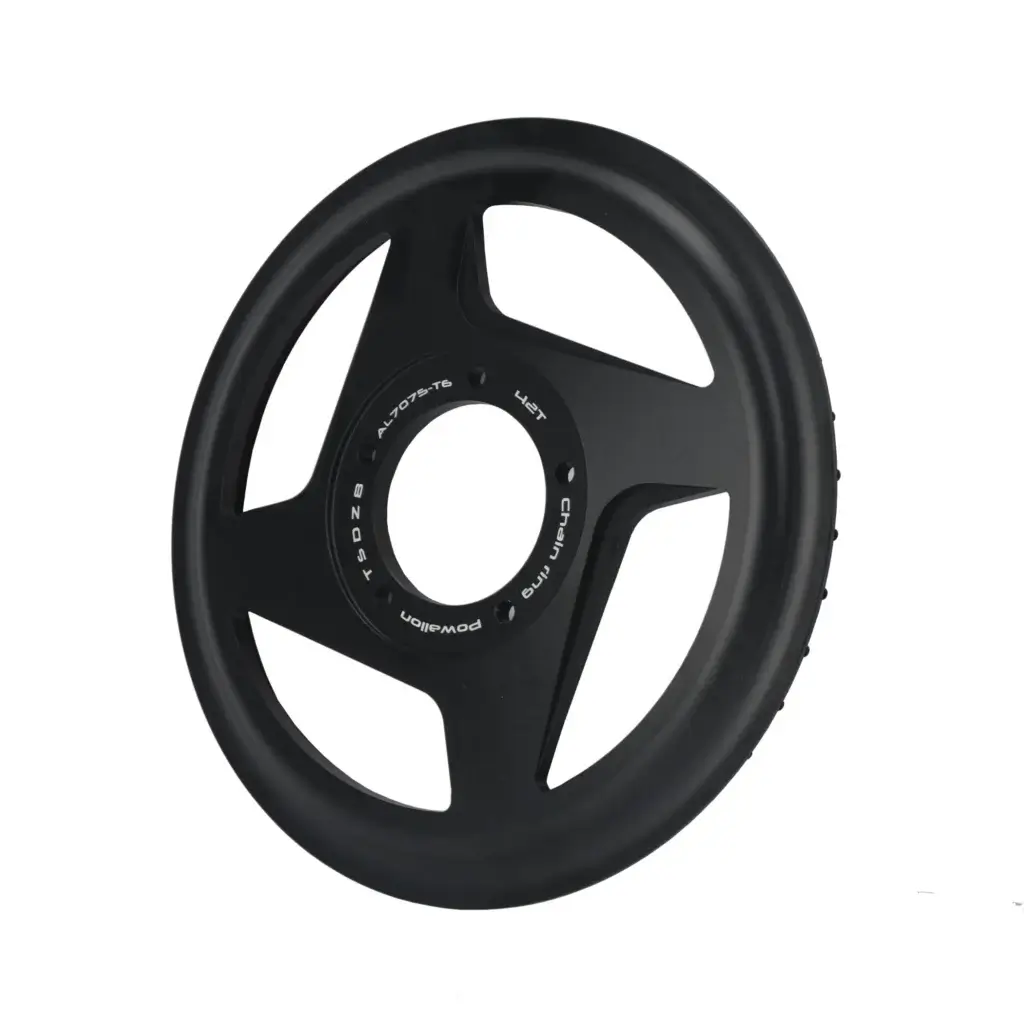
Mounting Interfaces on TSDZ8
The TSDZ8 commonly appears in two flavors:
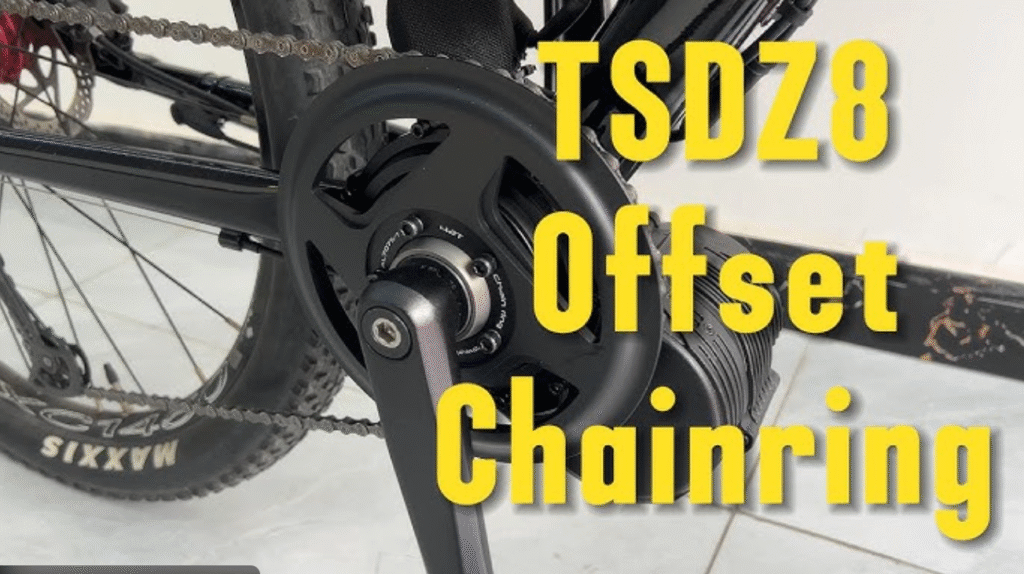
- Direct-mount (DM) chainring bolted to the motor’s carrier.
- Spider adapter + BCD (usually 104 BCD, sometimes 110), allowing you to run standard aftermarket rings.
When to use which
- Direct-mount: clean look, simple stack, lower Q-factor; fewer ring choices unless you find a DM catalog with offsets/tooth options.
- Spider + 104 BCD: most flexible-huge ring selection (tooth counts, narrow-wide variants, bash guards), and easy offset tuning with “offset spiders” or dish-specific rings.
Tip: If you’re unsure and want parts availability, convert to 104 BCD via a spider.
Recommended: Concord Electric Bike Reviews
Chainline & Offset-What They Mean (and Why They Matter)
- Chainline: the distance from the bike’s centerline to the center of the chainring teeth. Matching the chainline to your rear system (cassette or IGH) keeps the chain running straight in middle gears, reduces noise and wear, and prevents derail issues.
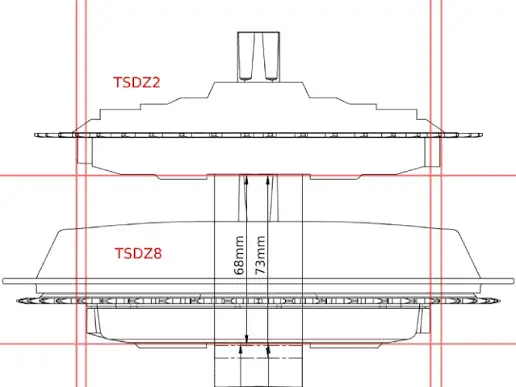
- Offset: how far a chainring or spider pushes the teeth inboard or outboard relative to the mounting face. You use offset to move the chainline where it needs to be.
Typical target chainlines
- External derailleur/cassette: ~49-52 mm (Boost setups often 52-55 mm).
- IGH / single-speed: check the hub’s spec; typical 44-50 mm.
Rule of thumb: Set chainline first, then choose tooth count. Good chainline is the foundation of quiet, reliable shifting.
Tooth Count & Tooth Profile Basics
- Tooth count changes gearing: smaller rings = easier climbing and better slow-speed control; larger rings = higher cruising/top speed.
- Narrow-wide (NW) profiles improve chain retention in derailleur systems by alternating narrow and wide teeth that better match inner/outer chain plates.
- Speed compatibility: a 12-speed chain needs a 12-speed-compatible NW ring for quiet, reliable running. 9/10/11-speed rings are more forgiving among themselves, but 12-speed is pickier.
- IGH/Single-speed: check chain width (1/8″ vs 3/32″) and pick a ring that matches.
Recommended: Trek Electric Bike Review 2025: Pros, Cons, and Best Models
Step 1 – Measure Before You Buy (Three-Step Chainline Method)
The Three-Step Chainline Method (Hands-On Checklist)
- Measure the current chainline.
- Use calipers or a ruler to measure from the frame centerline (or seat tube center) to the tooth center plane. On many setups, measuring from the BB shell/seat tube to the ring plane and subtracting half the shell width works well. Note the value.
- Identify your rear system target.
- Cassette: aim ~49-52 mm (Boost 52-55 mm).
- IGH/SS: consult hub spec; many land 44-50 mm.
- Determine the needed shift (offset).
- If your measured chainline is 4 mm too far outboard, you’ll want a ring/spider with ~4 mm more inboard offset (or a stack change that moves it inward).
Compatibility Pre-Flight (Quick Checklist)
- Wheel/hub type: 135/142/148 Boost/IGH
- Cassette range (11-36, 11-42, 11-51, etc.)
- Chain speed (9-12) or 1/8″ vs 3/32″ for IGH/SS
- Clearances: chainring to motor housing, chainstay, and chain guard; aim for ≥ 3-5 mm at all points
- Q-factor concerns: adding thick spiders/spacers can widen stance-keep it reasonable.
Recommended: Best Electric Bikes for Seniors 2025: Complete Safety & Comfort Guide
Step 2 – Choose Your Chainring (Interface × Offset × Teeth × Profile)
Pick the Interface: Direct-Mount vs. 104/110 BCD Spider
- Stay Direct-Mount if you find a DM ring with the right offset and tooth count. It’s simpler.
- Use a 104 BCD spider if you want max choice (36-48T typical), easier access to 12-speed NW profiles, and the option to add a bash/chainguard.
Note on “offset spiders/rings”: Some 104 BCD spiders and rings are purposely dished to move chainline inward or outward-very helpful on mid-drives.
Pick the Offset (How Much and How To Get It)
- Prefer built-in offset (offset DM ring or offset spider) to avoid tall stacks.
- Fine-tune with 0.5-2.0 mm shims only if needed; confirm bolt engagement remains ≥ 5-6 thread pitches.
- Watch Q-factor and clearance when adding offset/shims.
Pick the Tooth Count (By Terrain & Wheel Size)
Use cadence × speed × wheel circumference to estimate, but here are proven bands:
| Riding Emphasis | Recommended Tooth Count | Notes |
|---|---|---|
| Climbing / slow control (city hills, loaded) | 36-40T | Easier starts, better modulation; lower top speed |
| Mixed commuter / all-round | 40-44T | Balanced; fits 700C/27.5/29 with common cassettes |
| Fast flatland / long descents | 46-48T | Check clearances carefully (motor cover, guard, stay) |
Practical method: set your most used cadence (e.g., 80-90 rpm) and cruise speed, then choose a tooth count that makes that pairing land in a mid-cassette sprocket. You’ll shift less, wear less, and ride quieter.
Pick the Tooth Profile (By Drivetrain)
- External derailleur: Narrow-wide is highly recommended; pick 12-speed-rated NW for 12-speed chains specifically.
- IGH / single-speed: match chain width (1/8″ vs 3/32″). NW can help, but retention devices (e.g., a simple top guide) may be more effective if chainline is marginal.
Recommended: Best Recommended Durable Hydraulic Brake Conversion Kits for Electric Bikes
Step 3 – Installation & Tuning (Do It Once, Do It Right)
Pre-Install Checks
- Hardware: correct chainring bolts (length for your stack), medium-strength threadlocker, shims if planned.
- Clearance: dry-fit to confirm ≥ 3-5 mm to motor housing, chainstay, and guard.
- Torque spec: use the ring/spider manufacturer’s torque; don’t guess.
- Derailleur health: verify hanger alignment and cassette wear before you judge the new ring.
Install Steps (Numbered for a Shop-Manual Feel)
- Dry-fit ring/spider with planned offset/shims; rotate cranks and check all clearances.
- Final fit & torque: apply threadlocker; torque bolts to spec in a star pattern.
- Rear derailleur tune: re-set B-screw, L/H limits, and cable tension (chainline changes affect shifting feel).
- Chain length: with different tooth count/offset, you may need +1 or −1 link; check big-big (no derailleur) and small-small slack.
- Guard/guide: if you run a bash/guide, align and confirm no rub through the full gear range.
Road-Test Validation
- Free-spin the drivetrain; listen for rubbing or ticking.
- Middle cogs: confirm near-straight chain and quiet running.
- Extremes (big-big and small-small): ensure no chain rub on ring, chainstay, or guard; shifting should remain crisp.
- Load tests: hill starts and short sprints-no drops, no grinding, normal temps.
Troubleshooting-Fixes for Real-World Problems
Drops or Clicking Under Load
- Recheck chainline (likely off).
- Confirm ring speed-rating (e.g., 12-speed chain on non-12-speed NW often ticks or climbs teeth).
- Inspect chain wear; a stretched chain won’t hold on an NW ring.
- Consider a top guide if off-road/rough surfaces are common.
Interference / Rubbing
- Add or reduce offset (different ring or spider); don’t stack many shims.
- Confirm motor cover and chainstay clearances under full torque (frame flex).
Poor Shifting After Swap
- Re-do derailleur B-tension and limits; verify cable tension and cassette health.
- Revisit chain length-too short causes binding in big-big; too long causes slack/noisy small-small.
Cadence or Speed Not Where You Want
- Use the cadence × speed table approach to move 2T-4T up or down.
- Alternatively, adjust cassette range (e.g., add a larger big cog for hills).
Quick-Pick Matrix (Common Needs → Standard Choices)
| Need | Go-To Setup | Why |
|---|---|---|
| Maximum hill control | 36-38T NW + slight inboard offset | Softer gearing, straighter chain in climbing gears |
| Balanced commuter | 40-44T NW | Best mix of cadence and speed for 700C/27.5 |
| High-speed emphasis | 46-48T (verify clearances) | Better cruise/top speed; mind motor/guard clearance |
| Chronic chain drops | NW ring + upper guide | Retains chain in rough terrain |
| Chainline off | Offset DM ring / offset 104 spider + 0.5-2 mm shims | Move chainline precisely without huge stacks |
Buying & Checklist (Avoid Returns)
Shopping List
- Offset DM ring or 104/110 BCD spider + NW chainring with the correct speed rating
- Chainring bolts of correct length, optional shims (0.5-2.0 mm)
- Threadlocker (medium strength), optional bash/chainguard
- New chain (if old is near wear limit), optional top guide
Acceptance Tips
- Test-fit before fully installing; measure offset and compare your chainline to target.
- Keep packaging intact until the road test passes. Photograph clearances for records.
Maintenance & Service Life
- Monthly: wipe ring, check bolt torque, measure chain wear with a chain checker (0.5% / 0.75% markers for 11/12-speed).
- Quarterly: eyeball chainline on middle cogs; verify no new rub marks; re-grease/rewax chain as needed.
- After wet/gritty rides: rinse, dry, and lube; grit accelerates NW wear and chain stretch.
Reference Video
FAQs
Can the TSDZ8 run 104 BCD rings?
Yes-use a spider adapter and you’ll access a large aftermarket of 104 BCD rings, including offset and NW options. It’s the most flexible path if you change gearing often.
How do I decide the right offset?
Measure your current chainline, compare to the rear target (cassette 49-52 mm; Boost 52-55 mm; IGH 44-50 mm), and pick a DM or spider that moves you inboard/outboard by the difference. Use thin shims only for fine-tuning.
Do 12-speed chains require a special ring?
Yes-choose a 12-speed-compatible NW ring. Running a 12-speed chain on an older NW profile often causes ticking, noise, and dropped chains.
Will a bash/chainguard hit the motor cover or chainstay?
It can. Always dry-fit and ensure ≥ 3-5 mm clearance to the motor housing and stays. If tight, consider a smaller ring or a different offset solution.
I need easier climbing-change ring or cassette?
For big changes in feel, drop chainring teeth (e.g., 44→38T). If you already like your cruise cadence but only need slightly lower climbing gears, consider a wider-range cassette.